During the Medieval period the foundation was laid for the notational
and theoretical practices that would shape Western music into the norms
that developed during the
common-practice era. The most obvious of these is the development of a comprehensive
music notational
system which enabled composers to write out their songs and pieces on
parchment or paper. Prior to the development of musical notation, songs
and pieces had to be learned "by ear", from one person who knew a song
to another person. This greatly limited the geographic spread of songs
or pieces. The development of music notation made it easier to
disseminate songs and musical pieces to a larger geographic area.
However the theoretical advances, particularly in regard to
rhythm—the timing of notes—and
polyphony—using multiple, interweaving
melodies at the same time—are equally important to the development of Western music.
Instruments
Many instruments used to perform medieval music still exist in the 2010s, but in different and typically more
technologically developed forms. The
flute was once made of
wood rather than
silver or other
metal,
and could be made as a side-blown or end-blown instrument. While modern
orchestral flutes are usually made of metal and have complex key
mechanisms, medieval flutes had holes that the performer had to cover
with the fingers (as with the recorder). The
recorder
was made of wood during the Medieval era, and despite the fact that in
the 2000s, it may be made of synthetic materials, it has more or less
retained its past form. The
gemshorn is similar to the recorder as it has finger holes on its front, though it is actually a member of the
ocarina family. One of the flute's predecessors, the
pan flute, was popular in medieval times, and is possibly of
Hellenic origin. This instrument's pipes were made of wood, and were graduated in length to produce different pitches.
Medieval music used many plucked
string instruments like the
lute,
mandore,
gittern and
psaltery. The
dulcimers, similar in structure to the
psaltery and
zither,
were originally plucked, but musicians began to strike the dulcimer
with hammers in the 14th century after the arrival of new metal
technology that made metal strings possible.
The bowed
lyra of the
Byzantine Empire was the first recorded European bowed string instrument. The
Persian geographer
Ibn Khurradadhbih of the 9th century (d. 911) cited the
Byzantine lyra, in his lexicographical discussion of instruments as a bowed instrument equivalent to the Arab
rabāb and typical instrument of the Byzantines along with the
urghun (
organ),
shilyani (probably a type of
harp or
lyre) and the
salandj (probably a
bagpipe).
[1] The
hurdy-gurdy was (and still is) a mechanical
violin using a rosined wooden wheel attached to a crank to "bow" its strings. Instruments without sound boxes like the
jaw harp were also popular in the time. Early versions of the
organ,
fiddle (or
vielle), and a precursor to the modern
trombone (called the
sackbut) existed.
Genres
Medieval music for both
sacred (church use) and
secular (non-religious use) was composed.
[2] During the
earlier medieval period, the
liturgical genre, predominantly
Gregorian chant, was
monophonic ("monophonic" means a single melodic line, without a harmony part or instrumental accompaniment).
[3] Polyphonic genres, in which multiple independent melodic lines are performed simultaneously, began to develop during the
high medieval era, becoming prevalent by the later 13th and early 14th century. The development of such forms is often associated with the
Ars nova style.
The earliest innovations upon monophonic plainchant were
heterophonic.
"Heterophony" is the performance of the same melody by two different
performers at the same time, in which each performer slightly alters the
ornaments she is using. The
Organum, for example, expanded upon plainchant melody using an accompanying line, sung at a fixed
interval (often a
perfect fifth or
perfect fourth), with a resulting alternation between a simple form of polyphony and monophony.
[4] The principles of the organum date back to an anonymous 9th century tract, the
Musica enchiriadis,
which established the tradition of duplicating a preexisting plainchant
in parallel motion at the interval of an octave, a fifth or a fourth.
[5]
Of greater sophistication was the
motet, which developed from the
clausula genre of medieval
plainchant. The motet would become the most popular form of medieval polyphony.
[6]
While early motets were liturgical or sacred (designed for use in a
church service), by the end of the thirteenth century the genre had
expanded to include secular topics, such as
courtly love. Courtly love was the respectful veneration of a lady from afar by an amorous suitor.
During the
Renaissance music era, the Italian secular genre of the
Madrigal
also became popular. Similar to the polyphonic character of the motet,
madrigals featured greater fluidity and motion in the leading line. The
madrigal form also gave rise to polyphonic
canons, especially in Italy where they were composed under the title
Caccia.
These were three-part secular pieces, which featured the two higher
voices in canon, with an underlying instrumental long-note
accompaniment.
[7]
Finally, purely instrumental music also developed during this period,
both in the context of a growing theatrical tradition and for
court
performances for the aristocracy. Dance music, often improvised around
familiar tropes, was the largest purely instrumental genre.
[8] The secular
Ballata, which became very popular in
Trecento Italy, had its origins, for instance, in medieval instrumental dance music.
[9]
Theory and notation
During
the Medieval period the foundation was laid for the notational and
theoretical practices that would shape Western music into the norms that
developed during the
common practice era. The most obvious of these is the development of a comprehensive
music notational
system; however the theoretical advances, particularly in regard to
rhythm and polyphony, are equally important to the development of
Western music.
Notation
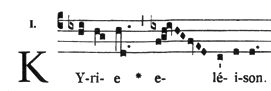
A sample of
Kýrie Eléison XI (Orbis Factor) from the
Liber Usualis. The "neume" markings above the text of the song indicate whether the
melody goes up or down in pitch.
Listen to it interpreted.
The earliest Medieval music did not have any kind of notational system. The tunes were primarily monophonic (a single
melody without
accompaniment) and transmitted by oral tradition.
[3]
As Rome tried to centralize the various liturgies and establish the
Roman rite as the primary church tradition the need to transmit these
chant melodies across vast distances effectively was equally glaring.
[10]
So long as music could only be taught to people "by ear", it limited
the ability of the church to get different regions to sing the same
melodies, since each new person would have to spend time with a person
who already knew a song and learn it "by ear". The first step to fix
this problem came with the introduction of various signs written above
the chant texts to indicate direction of pitch movement, called
neumes.
[3]
The origin of
neumes is unclear and subject to some debate;
however, most scholars agree that their closest ancestors are the
classic Greek and Roman grammatical signs that indicated important
points of declamation by recording the rise and fall of the voice.
[11] The two basic signs of the classical grammarians were the
acutus, /, indicating a raising of the voice, and the
gravis,
\, indicating a lowering of the voice. A singer reading a chant text
with neume markings would be able to get a general sense of whether the
melody line went up in pitch, stayed the same, or went down in pitch.
For a singer who already knew a song, seeing the written neume markings
above the text could help to jog his or her memory about how the melody
went. However, a singer reading a chant text with neume markings would
not be able to
sight read a song which he or she had never heard sung before.
These neumes eventually evolved into the basic symbols for
neumatic notation, the
virga (or "rod") which indicates a higher note and still looked like the
acutus from which it came; and the
punctum (or "dot") which indicates a lower note and, as the name suggests, reduced the
gravis symbol to a point.
[11] These the
acutus and the
gravis could be combined to represent graphical vocal inflections on the syllable
[12]
This kind of notation seems to have developed no earlier than the
eighth century, but by the ninth it was firmly established as the
primary method of musical notation.
[13] The basic notation of the
virga and the
punctum remained the symbols for individual notes, but other
neumes soon developed which showed several notes joined together. These new
neumes—called ligatures—are essentially combinations of the two original signs.
[14]
The first music notation was the use of dots over the lyrics to a
chant, with some dots being higher or lower, giving the reader a general
sense of the direction of the melody. However, this form of notation
only served as a memory aid for a singer who already knew the melody.
[15]This basic
neumatic
notation could only specify the number of notes and whether they moved
up or down. There was no way to indicate exact pitch, any rhythm, or
even the starting note. These limitations are further indication that
the
neumes were developed as tools to support the practice of
oral tradition, rather than to supplant it. However, even though it
started as a mere memory aid, the worth of having more specific notation
soon became evident.
[13]
The next development in musical notation was "heighted
neumes", in which
neumes were carefully placed at different heights in relation to each other. This allowed the
neumes
to give a rough indication of the size of a given interval as well as
the direction. This quickly led to one or two lines, each representing a
particular note, being placed on the music with all of the
neumes
relating back to them. At first, these lines had no particular meaning
and instead had a letter placed at the beginning indicating which note
was represented. However, the lines indicating middle C and the F a
fifth below slowly became most common. Having been at first merely
scratched on the parchment, the lines now were drawn in two different
colored inks: usually red for F, and yellow or green for C. This was the
beginning of the musical staff as we know it today.
[16] The completion of the four-line staff is usually credited to
Guido d’ Arezzo
(c. 1000-1050), one of the most important musical theorists of the
Middle Ages. While older sources attribute the development of the staff
to Guido, some modern scholars suggest that he acted more as a codifier
of a system that was already being developed. Either way, this new
notation allowed a singer to learn pieces completely unknown to him in a
much shorter amount of time.
[10][17] However, even though chant notation had progressed in many ways, one fundamental problem remained: rhythm. The
neumatic notational system, even in its fully developed state, did not clearly define any kind of rhythm for the singing of notes.
[18]
Music theory
 |
This section needs expansion. You can help by adding to it. (December 2014) |
The
music theory of the Medieval period saw several advances over previous practice both in regard to tonal material, texture, and rhythm.
Rhythm
Pérotin, "Alleluia nativitas", in the third rhythmic mode.
Concerning
rhythm,
this period had several dramatic changes in both its conception and
notation. During the early Medieval period there was no method to notate
rhythm, and thus the rhythmical practice of this early music is subject
to heated debate among scholars.
[18]
The first kind of written rhythmic system developed during the 13th
century and was based on a series of modes. This rhythmic plan was
codified by the music theorist
Johannes de Garlandia, author of the
De Mensurabili Musica (c.1250), the treatise which defined and most completely elucidated these
rhythmic modes.
[19] In his treatise Johannes de Garlandia describes six
species
of mode, or six different ways in which longs and breves can be
arranged. Each mode establishes a rhythmic pattern in beats (or
tempora) within a common unit of three
tempora (a
perfectio) that is repeated again and again. Furthermore, notation without text is based on chains of
ligatures (the characteristic notations by which groups of notes are bound to one another).
The rhythmic mode can generally be determined by the patterns of ligatures used.
[20]
Once a rhythmic mode had been assigned to a melodic line, there was
generally little deviation from that mode, although rhythmic adjustments
could be indicated by changes in the expected pattern of ligatures,
even to the extent of changing to another rhythmic mode.
[21] The next step forward concerning rhythm came from the
German theorist
Franco of Cologne. In his treatise
Ars cantus mensurabilis
("The Art of Mensurable Music"), written around 1280, he describes a
system of notation in which differently shaped notes have entirely
different rhythmic values. This is a striking change from the earlier
system of de Garlandia. Whereas before the length of the individual note
could only be gathered from the mode itself, this new inverted
relationship made the mode dependent upon—and determined by—the
individual notes or
figurae that have incontrovertible durational values,
[22]
an innovation which had a massive impact on the subsequent history of
European music. Most of the surviving notated music of the 13th century
uses the rhythmic modes as defined by Garlandia. The step in the
evolution of rhythm came after the turn of the 13th century with the
development of the
Ars Nova style.
The theorist who is most well recognized in regard to this new style is
Philippe de Vitry, famous for writing the
Ars Nova ("New Art") treatise around 1320. This treatise on music gave its name to the style of this entire era.
[23]
In some ways the modern system of rhythmic notation began with Vitry,
who completely broke free from the older idea of the rhythmic modes. The
notational predecessors of modern time meters also originate in the
Ars Nova. This new style was clearly built upon the work of Franco of Cologne. In Franco's system, the relationship between a
breve and a
semibreves (that is, half breves) was equivalent to that between a breve and a long: and, since for him
modus was always perfect (grouped in threes), the
tempus
or beat was also inherently perfect and therefore contained three
semibreves. Sometimes the context of the mode would require a group of
only two semibreves, however, these two semibreves would always be one
of normal length and one of double length, thereby taking the same space
of time, and thus preserving the perfect subdivision of the
tempus.
[24] This ternary division held for all note values. In contrast, the
Ars Nova
period introduced two important changes: the first was an even smaller
subdivision of notes (semibreves, could now be divided into
minim), and the second was the development of "mensuration."
Mensurations could be combined in various manners to produce metrical
groupings. These groupings of mensurations are the precursors of simple
and compound meter.
[25] By the time of
Ars Nova, the perfect division of the
tempus
was not the only option as duple divisions became more accepted. For
Vitry the breve could be divided, for an entire composition, or section
of one, into groups of two or three smaller semibreves. This way, the
tempus (the term that came to denote the division of the breve) could be either "perfect," (
Tempus perfectus) with ternary subdivision, or "imperfect,"(
Tempus imperfectus) with binary subdivision.
[26] In a similar fashion, the semibreve's division (termed
prolation) could be divided into three
minima (
prolatio perfectus or major prolation) or two
minima (
prolatio imperfectus or minor prolation) and, at the higher level, the
longs division (called
modus) could be three or two breves (
modus perfectus or perfect mode, or
modus imperfectus or imperfect mode respectively).
[27][28]
Vitry took this a step further by indicating the proper division of a
given piece at the beginning through the use of a "mensuration sign,"
equivalent to our modern "time signature.
[29]
Tempus perfectus was indicated by a circle, while
tempus imperfectus was denoted by a half-circle
[29]
(our current "C" as a stand-in for the 4/4 time signature is actually a
holdover from this practice, not an abbreviation for "common time", as
popularly believed). While many of these innovations are ascribed to
Vitry, and somewhat present in the
Ars Nova treatise, it was a contemporary—and personal acquaintance—of de Vitry, named
Johannes de Muris (
Jehan des Mars) who offered the most comprehensive and systematic treatment of the new mensural innovations of the
Ars Nova[25] (for a brief explanation of the mensural notation in general, see the article
Renaissance music).
Many scholars, citing a lack of positive attributory evidence, now
consider "Vitry's" treatise to be anonymous, but this does not diminish
its importance for the history of rhythmic notation. However, this makes
the first definitely identifiable scholar to accept and explain the
mensural system to be de Muris, who can be said to have done for it what
Garlandia did for the rhythmic modes.
For the duration of the medieval period, most music would be composed
primarily in perfect tempus, with special effects created by sections
of imperfect tempus; there is a great current controversy among
musicologists as to whether such sections were performed with a breve of
equal length or whether it changed, and if so, at what proportion. This
Ars Nova style remained the primary rhythmical system until the highly syncopated works of the
Ars subtilior at the end of the 14th century, characterized by extremes of notational and rhythmic complexity.
[30] This sub-genera pushed the rhythmic freedom provided by
Ars Nova
to its limits, with some compositions having different voices written
in different tempus signatures simultaneously. The rhythmic complexity
that was realized in this music is comparable to that in the 20th
century.
[31]
Polyphony
Pérotin's
Viderunt omnes, ca. 13th century.
Of equal importance to the overall history of western music theory
were the textural changes that came with the advent of polyphony. This
practice shaped western music into the harmonically-dominated music that
we know today.
[32] The first accounts of this textual development were found in two anonymous yet widely circulated treatises on music, the
Musica and the
Scolica enchiriadis. These texts are dated to sometime within the last half of the ninth century.
[33] The treatises describe a technique that seemed already to be well established in practice.
[33]
This early polyphony is based on three simple and three compound
intervals. The first group comprises fourths, fifths, and octaves; while
the second group has octave-plus-fourths, octave-plus-fifths, and
double octaves.
[33] This new practice is given the name
organum by the author of the treatises.
[33] Organum can further be classified depending on the time period in which it was written. The early
organum as described in the
enchiriadis can be termed "strict
organum"
[34] Strict
organum can, in turn, be subdivided into two types:
diapente (organum at the interval of a fifth) and
diatesseron (organum at the interval of a fourth).
[34] However, both of these kinds of strict
organum
had problems with the musical rules of the time. If either of them
paralleled an original chant for too long (depending on the mode) a
tritone would result.
[35]
This problem was somewhat overcome with the use of a second type of
organum. This second style of
organum was called "free
organum".
Its distinguishing factor is that the parts did not have to move only
in parallel motion, but could also move in oblique, or contrary motion.
This made it much easier to avoid the dreaded tritone.
[36] The final style of
organum that developed was known as "
melismatic organum",
which was a rather dramatic departure from the rest of the polyphonic
music up to this point. This new style was not note against note, but
was rather one sustained line accompanied by a florid melismatic line.
[37] This final kind of
organum was also incorporated by the most famous polyphonic composer of this time—
Léonin. He united this style with measured
discant passages, which used the rhythmic modes to create the pinnacle of
organum composition.
[37] This final stage of
organum is sometimes referred to as
Notre Dame school of polyphony, since that was where Léonin (and his student
Pérotin)
were stationed. Furthermore, this kind of polyphony influenced all
subsequent styles, with the later polyphonic genera of motets starting
as a trope of existing Notre Dame
organums.
Another important element of Medieval music theory was the unique
tonal system by which pitches were arranged and understood. During the
Middle Ages, this systematic arrangement of a series of whole steps and
half steps, what we now call a
scale, was known as a
mode. The modal system worked like the scales of today, insomuch that it provided the rules and material for melodic writing.
[38] The eight church modes are:
Dorian,
Hypodorian,
Phrygian,
Hypophrygian,
Lydian,
Hypolydian,
Mixolydian, and
Hypomixolydian.
[39]
Much of the information concerning these modes, as well as the
practical application of them, was codified in the 11th century by the
theorist
Johannes Afflighemensis. In his work he describes three defining elements to each mode. The
finalis, the reciting tone, and the range. The
finalis
is the tone that serves as the focal point for the mode. It is also
almost always used as the final tone (hence the name). The reciting tone
(sometimes referred to as the tenor or
confinalis) is the tone
that serves as the primary focal point in the melody (particularly
internally). It is generally also the tone most often repeated in the
piece, and finally the range (or
ambitus) is the maximum proscribed tones for a given mode.
[40] The eight modes can be further divided into four categories based on their final (
finalis).
Medieval theorists called these pairs
maneriae and labeled
them according to the Greek ordinal numbers. Those modes that have d, e,
f, and g as their final are put into the groups
protus,
deuterus,
tritus, and
tetrardus respectively.
[41]
These can then be divided further based on whether the mode is
"authentic" or "plagal." These distinctions deal with the range of the
mode in relation to the final. The authentic modes have a range that is
about an octave (one tone above or below is allowed) and start on the
final, whereas the plagal modes, while still covering about an octave,
start a perfect fourth below the authentic.
[42] Another interesting aspect of the modal system is the universal allowance for altering B to Bb no matter what the mode.
[43]
The inclusion of this tone has several uses, but one that seems
particularly common is in order to avoid melodic difficulties caused,
once again, by the tritone.
[44]
These ecclesiastical modes, although they have Greek names, have
little relationship to the modes as set out by Greek theorists. Rather,
most of the terminology seems to be a misappropriation on the part of
the medieval theorists
[39]
Although the church modes have no relation to the ancient Greek modes,
the overabundance of Greek terminology does point to an interesting
possible origin in the liturgical melodies of the
Byzantine tradition. This system is called
oktoechos and is also divided into eight categories, called
echoi.
[45]
For specific medieval music theorists, see also:
Isidore of Seville,
Aurelian of Réôme,
Odo of Cluny,
Guido of Arezzo,
Hermannus Contractus,
Johannes Cotto (Johannes Afflighemensis),
Johannes de Muris,
Franco of Cologne,
Johannes de Garlandia (Johannes Gallicus),
Anonymous IV,
Marchetto da Padova (Marchettus of Padua),
Jacques of Liège,
Johannes de Grocheo,
Petrus de Cruce (Pierre de la Croix), and
Philippe de Vitry.
Early medieval music (before 1150)
Early chant traditions
Chant developed separately in several European centres. Although the most important were
Rome,
Hispania,
Gaul,
Milan, and
Ireland,
there were others as well. These chants were all developed to support
the regional liturgies used when celebrating the Mass there. Each area
developed its own chants and rules for celebration. In Spain and
Portugal,
Mozarabic chant was used and shows the influence of
North African music. The Mozarabic liturgy even survived through
Muslim
rule, though this was an isolated strand and this music was later
suppressed in an attempt to enforce conformity on the entire liturgy. In
Milan,
Ambrosian chant, named after
St. Ambrose, was the standard, while
Beneventan chant developed around
Benevento, another Italian liturgical center.
Gallican chant was used in Gaul, and
Celtic chant in Ireland and Great Britain.
Around AD 1011, the
Roman Catholic Church wanted to standardize the
Mass
and chant. At this time, Rome was the religious centre of western
Europe, and Paris was the political centre. The standardization effort
consisted mainly of combining these two (
Roman and
Gallican) regional liturgies.
Pope Gregory I and
Charlemagne sent trained singers throughout the
Holy Roman Empire to teach this new form of chant.
[46] This body of chant became known as
Gregorian Chant, named after
Pope Gregory I.
By the 12th and 13th centuries, Gregorian chant had superseded all the
other Western chant traditions, with the exception of the Ambrosian
chant in Milan and the Mozarabic chant in a few specially designated
Spanish chapels.
Early polyphony: organum
Around the end of the 9th century, singers in monasteries such as
St. Gall in
Switzerland began experimenting with adding another part to the chant, generally a
voice in
parallel motion, singing mostly in perfect
fourths or
fifths above the original tune (see
interval). This development is called
organum and represents the beginnings of
counterpoint and, ultimately,
harmony. Over the next several centuries, organum developed in several ways.
The most significant of these developments was the creation of "florid organum" around 1100, sometimes known as the
school of St. Martial
(named after a monastery in south-central France, which contains the
best-preserved manuscript of this repertory). In "florid organum" the
original tune would be sung in long notes while an accompanying voice
would sing many notes to each one of the original, often in a highly
elaborate fashion, all the while emphasizing the perfect
consonances
(fourths, fifths and octaves), as in the earlier organa. Later
developments of organum occurred in England, where the interval of the
third was particularly favoured, and where organa were likely improvised against an existing chant melody, and at
Notre Dame in Paris, which was to be the centre of musical creative activity throughout the thirteenth century.
Liturgical drama
Another musical tradition of Europe originating during the early Middle Ages was the
liturgical drama. In its original form, it may represent a survival of
Roman drama with Christian stories - mainly the
Gospel, the
Passion, and the
lives of the saints
- grafted on. Every part of Europe had some sort of tradition of
musical or semi-musical drama in the Middle Ages, involving acting,
speaking, singing and instrumental accompaniment in some combination.
These dramas were probably performed by travelling actors and musicians.
Many have been preserved sufficiently to allow modern reconstruction
and performance (for example the
Play of Daniel, which has been recently recorded).
Goliards
The
Goliards were
itinerant poet-musicians of Europe from the tenth to the middle of the thirteenth century. Most were scholars or
ecclesiastics,
and they wrote and sang in Latin. Although many of the poems have
survived, very little of the music has. They were possibly influential —
even decisively so — on the
troubadour-
trouvère
tradition which was to follow. Most of their poetry is secular and,
while some of the songs celebrate religious ideals, others are frankly
profane, dealing with drunkenness, debauchery and lechery. One of the
most important extant sources of Goliards chansons is the
Carmina Burana.
High medieval music (1150–1300)
Ars antiqua
The flowering of the
Notre Dame school of polyphony from around 1150 to 1250 corresponded to the equally impressive achievements in
Gothic architecture: indeed the centre of activity was at the cathedral of
Notre Dame
itself. Sometimes the music of this period is called the Parisian
school, or Parisian organum, and represents the beginning of what is
conventionally known as
Ars antiqua. This was the period in which
rhythmic notation first appeared in western music, mainly a context-based method of rhythmic notation known as the
rhythmic modes.
This was also the period in which concepts of
formal structure developed which were attentive to proportion,
texture,
and architectural effect. Composers of the period alternated florid and
discant organum (more note-against-note, as opposed to the succession
of many-note melismas against long-held notes found in the florid type),
and created several new musical forms:
clausulae, which were
melismatic sections of organa extracted and fitted with new words and further musical elaboration;
conductus, which was a song for one or more voices to be sung rhythmically, most likely in a procession of some sort; and
tropes,
which were additions of new words and sometimes new music to sections
of older chants. All of these genres save one were based upon chant;
that is, one of the voices, (usually three, though sometimes four)
nearly always the lowest (the tenor at this point) sang a chant melody,
though with freely composed note-lengths, over which the other voices
sang organum. The exception to this method was the conductus, a
two-voice composition that was freely composed in its entirety.
The
motet,
one of the most important musical forms of the high Middle Ages and
Renaissance, developed initially during the Notre Dame period out of the
clausula, especially the form using multiple voices as elaborated by
Pérotin, who paved the way for this particularly by replacing many of his predecessor (as canon of the cathedral)
Léonin's
lengthy florid clausulae with substitutes in a discant style.
Gradually, there came to be entire books of these substitutes, available
to be fitted in and out of the various chants. Since, in fact, there
were more than can possibly have been used in context, it is probable
that the clausulae came to be performed independently, either in other
parts of the mass, or in private devotions. The clausulae, thus
practised, became the motet when troped with non-liturgical words, and
were further developed into a form of great elaboration, sophistication
and subtlety in the fourteenth century, the period of
Ars nova. Surviving manuscripts from this era include the
Montpellier Codex,
Bamberg Codex, and
Las Huelgas Codex.
Composers of this time include
Léonin,
Pérotin,
W. de Wycombe,
Adam de St. Victor, and
Petrus de Cruce
(Pierre de la Croix). Petrus is credited with the innovation of writing
more than three semibreves to fit the length of a breve. Coming before
the innovation of imperfect tempus, this practice inaugurated the era of
what are now called "Petronian" motets. These late 13th-century works
are in three to four parts and have multiple texts sung simultaneously.
Originally, the tenor line (from the Latin
tenere,
"to hold") held a preexisting liturgical chant line in the original
Latin, while the text of the one, two, or even three voices above,
called the
voces organales, provided commentary on the liturgical subject either in Latin or in the vernacular French. The rhythmic values of the
voces organales decreased as the parts multiplied, with the
duplum (the part above the tenor) having smaller rhythmic values than the tenor, the
triplum (the line above the
duplum) having smaller rhythmic values than the
duplum, and so on. As time went by, the texts of the
voces organales became increasingly secular in nature and had less and less overt connection to the liturgical text in the tenor line.
[47]
The Petronian motet is a highly complex genre, given its mixture of
several semibreve breves with rhythmic modes and sometimes (with
increasing frequency) substitution of secular songs for chant in the
tenor. Indeed, ever-increasing rhythmic complexity would be a
fundamental characteristic of the 14th century, though music in France,
Italy, and England would take quite different paths during that time.
Cantigas de Santa Maria
Troubadours and trouvères
The music of the
troubadours and
trouvères
was a vernacular tradition of monophonic secular song, probably
accompanied by instruments, sung by professional, occasionally
itinerant, musicians who were as skilled as poets as they were singers
and instrumentalists. The language of the troubadours was
Occitan (also known as the
langue d'oc, or Provençal); the language of the trouvères was Old French (also known as
langue d'oil). The period of the troubadours corresponded to the flowering of cultural life in
Provence which lasted through the twelfth century and into the first decade of the thirteenth. Typical subjects of troubadour song were
war,
chivalry and
courtly love—the love of an idealized woman from afar. The period of the troubadours wound down after the
Albigensian Crusade, the fierce campaign by
Pope Innocent III to eliminate the
Cathar heresy (and northern barons' desire to appropriate the wealth of the south). Surviving troubadours went either to
Portugal,Spain,
northern Italy or northern France (where the trouvère tradition lived
on), where their skills and techniques contributed to the later
developments of secular musical culture in those places.
[46]
The trouvères and troubadours shared similar musical styes, but the trouvères were generally noblemen.
[46]
The music of the trouvères was similar to that of the troubadours, but
was able to survive into the thirteenth century unaffected by the
Albigensian Crusade. Most of the more than two thousand surviving
trouvère songs include music, and show a sophistication as great as that
of the poetry it accompanies.
The
Minnesinger tradition was the
Germanic
counterpart to the activity of the troubadours and trouvères to the
west. Unfortunately, few sources survive from the time; the sources of
Minnesang are mostly from two or three centuries after the peak of the
movement, leading to some controversy over the accuracy of these
sources. Among the Minnesingers with surviving music are
Wolfram von Eschenbach,
Walther von der Vogelweide, and
Niedhart von Reuenthal.
Trovadorismo
In the Middle Ages, Galician-Portuguese was the language used in
nearly all of Iberia for lyric poetry. From this language derive both
modern Galician and Portuguese. The Galician-Portuguese school, which
was influenced to some extent (mainly in certain formal aspects) by the
Occitan troubadours, is first documented at the end of the twelfth
century and lasted until the middle of the fourteenth.
The earliest extant composition in this school is usually agreed to
be Ora faz ost' o senhor de Navarra by the Portuguese João Soares de
Paiva, usually dated just before or after 1200. The troubadours of the
movement, not to be confused with the Occitan troubadours (who
frequented courts in nearby León and Castile), wrote almost entirely
cantigas. Beginning probably around the middle of the thirteenth
century, these songs, known also as cantares or trovas, began to be
compiled in collections known as cancioneiros (songbooks). Three such
anthologies are known: the Cancioneiro da Ajuda, the Cancioneiro
Colocci-Brancuti (or Cancioneiro da Biblioteca Nacional de Lisboa), and
the Cancioneiro da Vaticana. In addition to these there is the priceless
collection of over 400 Galician-Portugues cantigas in the Cantigas de
Santa Maria, which tradition attributes to Alfonso X.
The Galician-Portuguese cantigas can be divided into three basic
genres: male-voiced love poetry, called cantigas de amor (or cantigas
d'amor) female-voiced love poetry, called cantigas de amigo (cantigas
d'amigo); and poetry of insult and mockery called cantigas d'escarnho e
de mal dizer. All three are lyric genres in the technical sense that
they were strophic songs with either musical accompaniment or
introduction on a stringed instrument. But all three genres also have
dramatic elements, leading early scholars to characterize them as
lyric-dramatic.
The origins of the cantigas d'amor are usually traced to Provençal
and Old French lyric poetry, but formally and rhetorically they are
quite different. The cantigas d'amigo are probably rooted in a native
song tradition (Lang 1894
[full citation needed], Michaëlis 1904
[full citation needed]),
though this view has been contested. The cantigas d'escarnho e maldizer
may also (according to Lang) have deep local roots. The latter two
genres (totalling around 900 texts) make the Galician-Portuguese lyric
unique in the entire panorama of medieval Romance poetry.


